


Joro and the Morning Dew: A Golden Web in the Suburbs

At first light, the suburban street seems ordinary: quiet sidewalks, sleeping condominiums, clipped lawns, and the muffled hush of a neighborhood not yet fully awake. My morning walks usually offer familiar surprises along the wooded edges of the road—deer stepping cautiously between the trees, wild turkeys crossing with prehistoric confidence, rabbits vanishing into the brush. But on this particular morning, the wild had drawn its curtain across the path itself.
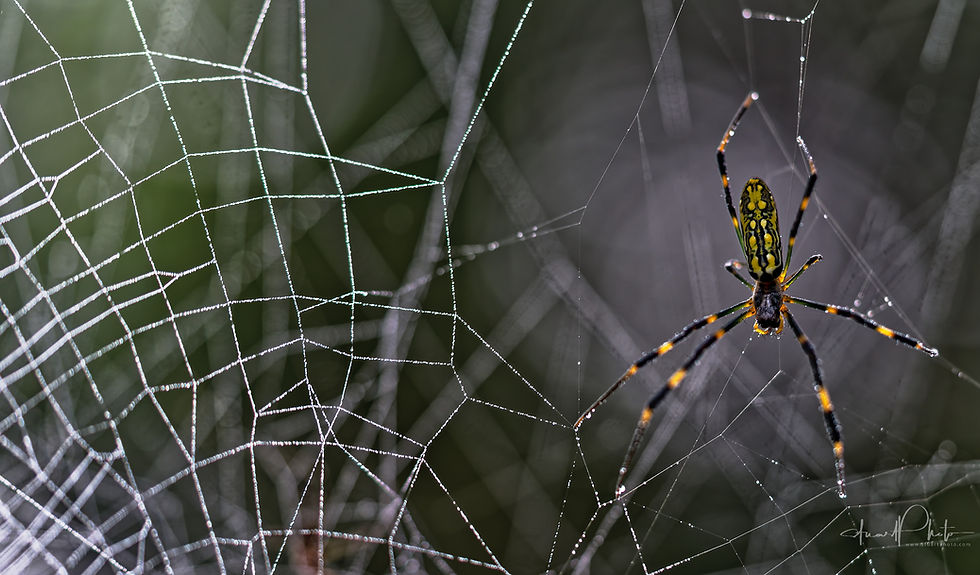
Suspended across nearly six to eight feet of sidewalk was the orb-shaped web of a Joro spider, its architecture stretched from one anchor point to another like a living net of silk. Dew had settled overnight on every strand. In the low morning light, each droplet turned the web into a constellation. At its center rested the Joro—Trichonephila clavata—a striking orb-weaver native to East Asia and now established in parts of the southeastern United States, including Tennessee. Large, vivid, and unmistakable, the female Joro wears bands of yellow, dark blue, and red, a pattern that seems almost too ornamental for an animal built by necessity.

The web itself is more than decoration. It is both home and hunting ground, a finely engineered trap designed to intercept passing insects. Orb-weavers are among nature’s great builders, spinning structures that are delicate in appearance yet remarkably resilient. On a dry afternoon, such a web might be easy to miss. But with morning dew clinging to the silk, the invisible becomes visible, and a hidden life of the neighborhood briefly reveals itself.
For a moment, the sidewalk was no longer simply a sidewalk. It was a boundary between two worlds: the human corridor of concrete and the spider’s aerial kingdom, suspended at eye level in the cool dampness of morning. The scene invited a pause, not fear. Despite their dramatic size and color, Joro spiders are generally reluctant to bite and are not considered a significant threat to people. Their real story is ecological—a tale of travel, adaptation, and the complicated ways introduced species settle into new landscapes.

Standing before that dew-bright web, I was reminded that wilderness does not always announce itself from mountaintops, forests, or distant preserves. Sometimes it waits behind a condominium complex, strung between shrubs and railings, glistening in the first light of day. The Joro spider, brilliant and still, had transformed an ordinary morning walk into a small expedition—proof that even in the suburbs, nature continues to build, hunt, adapt, and astonish.
Stuart F. James (sfj@stuartphoto.com)


Comments